The Analyst Advantage for Cybersecurity Vendors
Analyst relations is often treated as a nice-to-have, something to do when a report is coming out or a big event is on the calendar. In reality, it’s a strategic discipline that shapes how a company is perceived, positioned, and ultimately shortlisted in a crowded market. It’s a long-term, ongoing effort focused on building relationships, not a one-time briefing that begins only when an evaluation is underway.
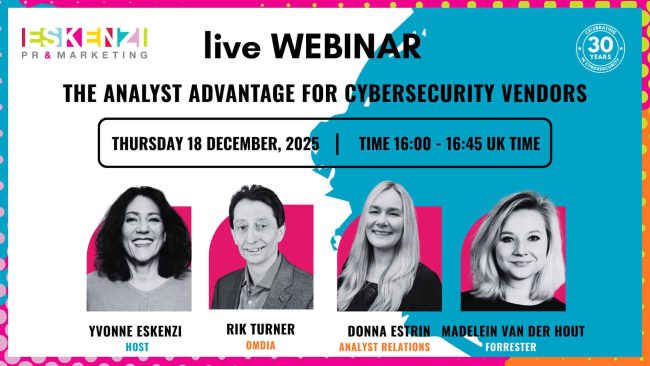
That was the central theme of a recent Eskenzi PR webinar hosted by Yvonne Eskenzi, Co-Founder, Eskenzi PR, featuring insights from Rik Turner, Chief Analyst, Cybersecurity – Omdia, Madelein van der Hout, Senior Analyst, Security & Risk – Forrester, and Donna Estrin, Principal – Estrin Communications. The conversation focused on why vendor briefings matter, how analysts use what they hear, and what strong analyst relations look like in practice, especially in cybersecurity, where differentiation is notoriously difficult.
Why brief analysts at all?
For vendors, the most immediate benefit of an analyst briefing is clarity. Analysts track markets across hundreds or thousands of vendors and translate that complexity into frameworks, research, and recommendations used by end users. A briefing helps an analyst understand where a company fits, what it actually does, and how it should be compared to alternatives.
In cybersecurity, that need is amplified by scale. With thousands of companies operating across overlapping categories, many vendors, particularly those that are privately held or earlier-stage, face a visibility problem. Analyst engagement can help address that, not through promotional coverage, but through accurate market understanding.
A key point from the discussion was that analyst relations is not public relations. Unlike media, analysts aren’t searching for the next headline. Their job is to get the story right, assess strengths and limitations, and reflect that in research and client guidance. That independence is precisely what makes their perspective valuable.
What analysts do with vendor input
Analysts don’t just publish reports; they spend substantial time in meetings and advisory sessions with end-user clients. Those conversations reveal what buyers are prioritising, where confusion exists, and which risks are driving industry-wide challenges. Vendor briefings become valuable input into a larger model that combines market observation, customer conversations, and research.
This creates a practical benefit for vendors: analysts can provide a reality check on messaging and positioning. Vendor narratives can drift toward internal assumptions or marketing language that doesn’t match how buyers think. A well-run briefing surfaces that gap early, before it becomes a sales or critical problem for the vendor.
Analysts also use briefings with vendors to validate market direction. Emerging topics can move from theoretical to urgent quickly. Turner discussed how post-quantum cryptography, once viewed as distant, is now driving more frequent end-user inquiries as organisations begin planning for long-term encryption resilience. In these moments, analysts need to understand which vendors are building credible capabilities and what maturity looks like in the real world.
Measuring impact, credibility and momentum
Strong analyst relations rarely produces value in a single interaction. The impact builds over time through consistent touchpoints, better mutual understanding, and stronger positioning. When a company appears in comparative research, or is accurately profiled and tracked, credibility increases. That credibility can translate into greater awareness with buyers, stronger inbound interest, and more confidence in shortlisting decisions.
However, the panel emphasised that this isn’t about “winning” an analyst. It’s about earning accurate representation. When vendors treat factual review as an opportunity to insert marketing language, they undermine trust and create unnecessary friction. The goal is precision: describe what the product does, how it goes to market, who it competes with, and what makes it meaningfully different.
Analyst relations on a budget
You don’t need a large analyst relations (AR) budget to start building productive analyst relationships. Briefings, event meetings, and consistent updates can create visibility and context. A simple quarterly email with product updates, major announcements, customer milestones, and clear positioning changes can be an effective way to maintain momentum. The common thread is consistency: analyst relations works best as a year-round program, not a last-minute scramble triggered by an evaluation cycle.
Top five tips for better analyst relations
- Treat it as a strategy, not publicity. Aim for accurate market understanding, not promotional validation.
- Lead with direction and differentiation. Explain where you’re headed, why it matters, and what you do better or differently.
- Be explicit about competitors. Analysts need to place you in the landscape, help them do it.
- Make briefings conversational and prepared. Bring the right people, answer questions directly, and avoid long introductions.
- Build relationships before evaluations start. Maintain consistent touchpoints throughout the year so you’re not “new” when it counts.
To help vendors put these analyst relations best practices into action, Eskenzi PR hosts the IT Security Analyst & CISO Forum, a highly focused, invitation-only event taking place on 13–14 April 2026 at the Clermont Charing Cross Hotel in central London.
The Forum is designed to fast-track meaningful engagement, giving vendors the opportunity to brief up to 10 analysts in a single day through a series of 30-minute sessions, gaining candid feedback on competitive positioning, messaging, and market perception.
The second day features an exclusive closed-door CISO roundtable, bringing together 10–12 senior CISOs who openly discuss what they are looking to invest in and where vendors often miss the mark. Every participating vendor can pose a question directly to the CISOs, creating a rare opportunity to gain unfiltered buyer insight and potential lead-generation value.
Previous attendees have gone on to build long-term analyst relationships, secure inclusion in major research reports, and better align their offerings with real-world CISO priorities.
If you’re keen on finding out more, please contact us straight away, and we’d be more than happy to jump on a call with Yvonne to discuss this further.