How AI Is Reshaping Brand Reputation
Marketers can’t afford to put AI on the back burner anymore. It is already changing how brands are discovered, evaluated and trusted, and the shift is happening faster than most organisations have prepared for.
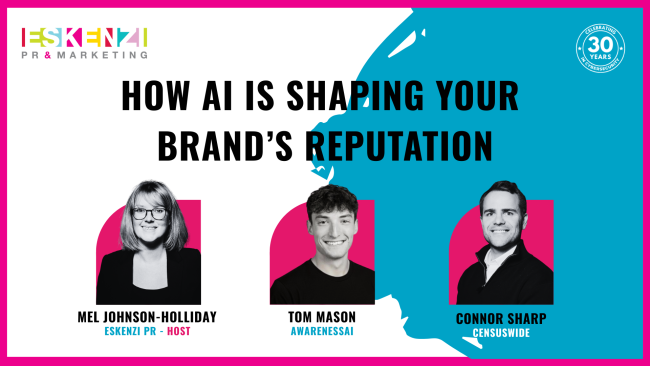
That was the key theme of our recent webinar, “How AI is Shaping Your Brand’s Reputation,” where a panel came together to unpack what AI-powered search really means for brands today. The session featured Tom Mason, founder of AwarenessAI, and Connor Sharp, Account Director at Censuswide, who brought both strategic insight and research to the table.
From Search Engines to Answer Engines
Not long ago, the typical buyer journey looked something like this: search on Google, click through a handful of links, do your own research and eventually land on a decision. That process took time, but it also gave brands multiple opportunities to make an impression.
Today, tools like ChatGPT, Claude and Gemini are combining that entire journey into a single step. Users ask a question and get a summarised answer, often with recommendations built right in. AI has gone from being a discovery tool to being the first point of contact between a brand and its potential customers.
Tom Mason described how this shift has given rise to a new discipline: Generative Engine Optimization, or GEO. While SEO is about getting your web pages to rank, GEO is about shaping how AI systems understand, describe and recommend your brand. It is a fundamentally different challenge, and most organisations have not started addressing it yet.
Why AI Representation Matters
One of the more eye-opening points from the webinar was how much trust people place in AI-generated responses. Even when those responses are incomplete or just plain wrong, users tend to treat them as reliable.
That creates a real problem for brands. AI systems are actively shaping how your company is perceived, summarising what you do, calling out your strengths and sometimes surfacing risks or negative information. Because these systems pull from a wide variety of sources, including forums like Reddit, brands have far less control over how they come across than they might think.
Common issues include outdated company descriptions, missing areas of expertise and in some cases, completely inaccurate information. The tricky part is that many businesses have no idea these narratives exist until AI starts repeating them at scale.
Mason’s advice was straightforward: consistency is everything. Your messaging, descriptions and contact details need to be aligned across every platform you are present on. Even small discrepancies can confuse AI systems and lead to distorted or misleading summaries.
The Rise of AI Recommendations
There is another layer to this beyond how your brand is described. AI is increasingly shaping buying decisions by generating shortlists and recommendations, rather than serving up pages of results for users to sift through. If your brand is not on that shortlist, you are effectively invisible.
Third-party content. Articles like “Top 10 Cybersecurity Companies” or “Best Cyber Vendors” are regularly used by AI systems as source material. That means earning placements in credible publications and industry lists is not only good PR, but part of a visibility strategy.
AI Is Already Driving Buying Decisions
Connor Sharp brought Censuswide research to the conversation, putting real numbers behind the trend. More than 90% of senior professionals now use AI search tools on a daily basis. Nearly half of consumers say they have made purchasing decisions based on AI recommendations.
And here is a number that should get every marketer’s attention: more than half of respondents said they would view a company negatively if it did not appear in AI search results at all. Therefore, visibility in AI is now directly tied to credibility and revenue.
What Marketers Should Do Next
Both speakers agreed that the starting point is simple: audit your current AI presence. Open up ChatGPT or a similar tool and ask how it describes your company. What does it say your strengths are? Would it recommend you? The answers can be surprisingly revealing.
From there, a few priorities stand out:
- Consistency across your website, social channels and third-party platforms is the foundation. Mixed or conflicting messages will work against you.
- Reputation management needs to expand to include monitoring what AI is saying about your brand, not just what appears in traditional search results.
- Content strategy should prioritise authoritative, high-quality material such as research reports, thought leadership articles and expert commentary that AI systems are likely to treat as credible sources.
- Visibility in credible publications and industry listicles will increasingly determine whether your brand makes it onto AI-generated shortlists.
- Collaboration between marketing, PR and insights teams is essential. Keeping those functions siloed makes it much harder to maintain a consistent and accurate narrative online.
A New Reality for Brand Management
The takeaway from the webinar was simple but important: your brand is already being interpreted by AI, whether you are managing that process or not.
As more people shift from browsing to simply asking AI for answers, the organisations that take their AI presence seriously will have a genuine competitive edge. Those that do not risk being misrepresented, overlooked or left out of the conversation entirely.
AI is not replacing traditional marketing but it is raising the stakes for how all of it needs to work together. For those brands willing to adapt, that is actually a significant opportunity. Don’t leave your brand’s AI presence to chance.
Get in touch with us and we’ll help you build a smart, future-proof AI and GEO strategy that will drive your visibility. Email us at: hello@eskenzipr.com