What Makes a Successful Cybersecurity PR Spokesperson?
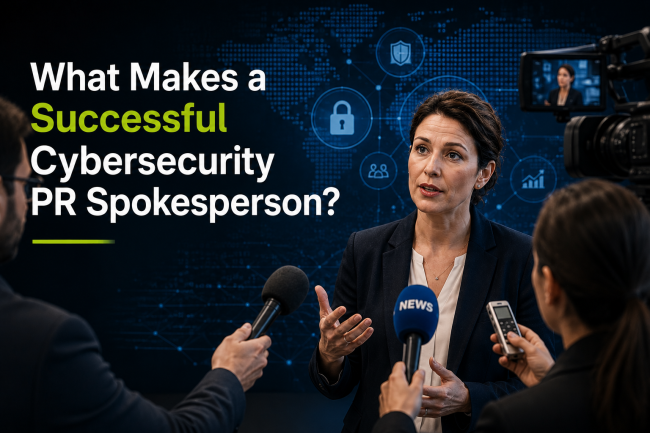
There is no shortage of smart people in the cybersecurity industry. Engineers who can reverse-engineer malware in their sleep, researchers who have spent years mapping threat actor behaviour, founders who built their companies on a genuinely novel insight into how attacks work. The problem is that technical brilliance and media readiness are entirely different skills, and confusing the two is one of the most common mistakes in cybersecurity PR.
A great spokesperson combines deep knowledge with the ability to translate it into something a journalist, a board member, or a prospective customer can actually use.
The Jargon Trap
The first thing that tends to derail a cybersecurity spokesperson is language. The sector runs on acronyms, vendor-specific terminology, and technical shorthand that means a great deal to practitioners and almost nothing to anyone outside them. When a spokesperson defaults to that language in a media interview, one of two things happens: the journalist loses the thread entirely, or they simplify so aggressively in their write-up that the quote no longer reflects what was actually said.
Good cybersecurity PR depends on spokespeople who have done the work of translating their expertise into plain language before they get on the call. The goal is not to dumb things down, but to find the analogy, the concrete example, or the real-world consequence that makes a complex idea land without losing its accuracy. The best spokespeople in this industry are the ones who can move between technical depth and accessible explanation without the join showing.
Opinion Over Summary
Journalists covering cybersecurity do not need another spokesperson to explain what happened in a breach or confirm that ransomware is a serious threat. They can read a vendor advisory for that. What they want is a perspective: a point of view that adds something to the story they are already writing, challenges an assumption, or offers a frame that their readers have not seen before.
This is where a lot of cybersecurity PR falls flat. Spokespeople who have been briefed to stay on-message often end up saying very little, retreating into safe generalities that a reporter will cut the moment something more interesting lands in their inbox. The spokespeople who get called back, who become go-to sources for specific beats, are the ones willing to say something with an edge, pushing back on conventional wisdom, naming a problem the industry is not talking about honestly, or offering a genuinely contrarian read on a trend.
That takes confidence, and it takes preparation. It also takes a Cybersecurity PR team willing to coach spokespeople toward that kind of intellectual courage rather than steering them away from anything that could be misread.
What Journalists Actually Notice
Beyond the substance of what a spokesperson says, there are qualities that experienced journalists pick up on quickly and that shape whether they come back to a source. Responsiveness is one: a spokesperson who turns around a comment within two hours during a breaking news cycle is worth ten who send a polished quote three days later when the story has moved on. Brevity is another; the ability to make a point in three sentences rather than three paragraphs is a genuine skill, and one that is rarer than it should be.
Authenticity matters too, in a way that is hard to manufacture. Reporters who cover cybersecurity full-time have heard every version of every talking point. They can tell the difference between someone who has thought carefully about an issue and someone who is reciting a brief. Effective cybersecurity PR builds spokespeople who have genuinely internalised their perspective rather than performing it.
The Role of Preparation
None of this happens by accident. The spokespeople who consistently perform well in media situations have usually been through structured preparation covering interview technique, message development, bridging practice, and the kind of honest feedback that tells them where they lost the thread or defaulted to jargon. Media training is not a one-time exercise done before a product launch; it is an ongoing investment that compounds over time as a spokesperson gets more comfortable under pressure and more confident in their own point of view.
For cybersecurity companies, this preparation is particularly important because the media environment moves so fast. A spokesperson who freezes when asked about a competitor’s breach, or who cannot answer a question about regulation without checking their notes, will not build the kind of credibility that sustains a long-term cybersecurity PR programme. The ones who do are the ones who have put in the work behind the scenes, with the right support alongside them.
Technical Knowledge Opens the Door
To be clear: deep subject matter expertise matters enormously. A spokesperson who does not understand the technology will be found out quickly by a sharp journalist, and the reputational damage that follows is hard to undo. But expertise alone gets you into the room, and what happens next depends on everything else. The spokespeople who genuinely move the dial for their companies, building personal profiles that outlast any single news cycle and becoming trusted voices in the industry, are the ones who have learned to wear that expertise lightly, to engage with curiosity, and to make the conversation about the issue rather than themselves.
That combination of depth, communication skill, and genuine perspective is what good cybersecurity PR helps to develop. It does not emerge fully formed. It is built, deliberately, over time. To find out more about how cybersecurity PR can help your Cybersecurity business use the Contact Page to get in touch.