AI Isn’t Destroying Journalism. It’s Raising the Bar
Ever since artificial intelligence (AI) burst into the mainstream, there’s been no shortage of headlines predicting the end of journalism, PR and content marketing as we know it. AI can write articles, produce press releases and generate social media posts in seconds, leading many to question whether human creativity and expertise will soon become obsolete.
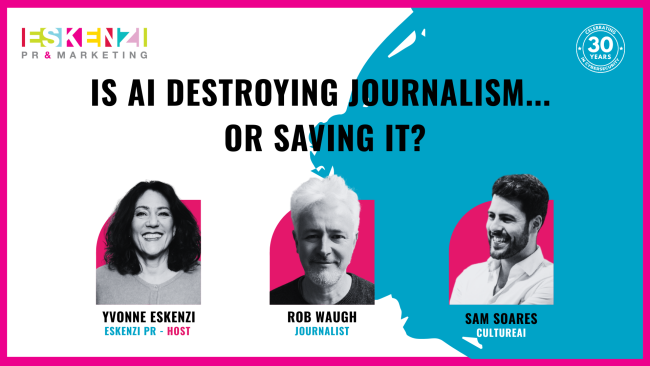
This is exactly the subject that was discussed on our recent webinar, Is AI saving journalism… or destroying it?, where Eskenzi PR co-founder, Yvonne Eskenzi was joined by well-known and influential journalist Rob Waugh and CultureAI’s CRO, Sam Soares. Rather than debating whether AI is good or bad, the conversation quickly focused on something much more important: trust and authenticity and real people.
The conclusion? AI isn’t replacing journalism or PR. It’s making quality, authenticity and relationships more valuable than ever before. Top of the agenda is people buy from people and like to people they like. Can a machine replicate the magic created by real people saying good honest, thoughtful, thought provoking content that you can actually learn from?
The conversation was a firm no! All three participants agreed and acknowledged that from all three perspectives, a journalist, a marketeer and a PR professional, the most important part of generating published content is that it must be authentic, credible and original with personality.
Can AI produce personalities? Isn’t that who we want to follow on social media and is at the route of producing compelling content – building people and companies with personality – or what was called in the old days a recognisable brand.
One of the biggest changes AI has brought isn’t simply that more content is being created. It’s that audiences are now faced with an overwhelming amount of information, making it increasingly difficult to know what deserves their attention. As asked during the webinar, if everyone can produce endless content at the click of a button, what actually makes people stop and listen?
For Sam, the answer was simple: “Content is becoming commoditised. Everyone can create it now. The real differentiator is trust – who is behind it and is the information factual.”
It’s a point that feels particularly relevant for marketers and communicators. For years, the challenge was producing enough content to keep websites, social channels and campaigns active. AI has solved that problem almost overnight. Now the challenge is creating content that people genuinely believe, engage with and remember.
Sam also warned against viewing AI purely as a cost-saving exercise, commenting, “The companies that win won’t be the ones producing the most content. They’ll be the ones combining AI with human expertise and insights.”
That balance between technology and people became a recurring theme throughout the discussion.
For Rob, AI hasn’t made journalism obsolete. If anything, it’s made the role of journalists even more important. The rise of AI-generated content, fake experts and synthetic media means reporters are spending as much time verifying information as they are uncovering and discovering real stories.
As he explained during the webinar, “We’re surrounded by fake experts, fake people and AI-generated information. More and more of the job is about making sure we are reporting the reality, not AI-generated opinions by AI-generated characters.”
It’s a powerful observation and one that perfectly captures the challenge facing journalism today.
Fact-checking has always been part of the profession, but now journalists are also having to establish whether the people behind the information they’re receiving are genuine in the first place.
That naturally led the conversation onto a question many PR professionals have quietly been asking themselves. Can journalists actually tell when a press release has been written by AI?
Rob’s response couldn’t have been clearer: “YES! If you can’t be bothered to write it, I can’t be bothered to read it.”
It wasn’t a criticism of AI itself. In fact, Rob was open about using AI to support elements of his own workflow. The problem isn’t the technology; it’s when organisations rely on it to replace original thinking. Generic, AI-generated pitches often lack personality, insight and the genuine expertise that journalists are looking for.
That point really resonated because, despite everything that’s changed, the fundamentals of good communications remain exactly the same. Journalists still want compelling stories, credible spokespeople and organisations that understand their audience. AI can help us work more efficiently, but it can’t replace curiosity, creativity or authentic human experience.
As Yvonne noted, “This whole thing is about being as authentic and honest as you possibly can.”
Perhaps that’s why relationships continue to matter so much.
This is where Rob offered some practical advice for anyone working in PR: “Read the journalist’s work. Understand what they cover. Be relevant. Don’t just send the same thing to hundreds of people.” He also reminded the audience that AI can’t always write your content better than you; it is nothing more than aid. Don’t let it swallow your own voice and personality.
It’s advice that predates AI by decades, but it’s arguably even more important in today’s world. When technology makes it easier than ever to automate outreach on mass, the organisations that invest in genuine relationships and tailored communications are the ones that will stand out.
Another interesting part of the discussion focused on transparency. Sam explained that when evaluating publishers or media platforms, one of the first questions he now asks is how they use AI; “I’m not against AI. I just want transparency. Tell me where you’re using it.”
That expectation is only likely to grow. Whether you’re a publisher, a journalist or a brand, audiences want to know where automation ends and human judgement begins.
The webinar ended by looking forward to the future, and despite all the discussion around AI, one clear message stood out above everything else. AI is undoubtedly changing journalism, marketing and communications, but it isn’t replacing the people behind them – and this is important – we want trusted sources with personality.
It can make us faster. It can help us research. It can even help us draft content. But it can’t build trust, develop relationships or uncover the stories that genuinely connect with people.
We’ve moved to a world where almost anyone can create convincing content in seconds and this has made authenticity one of the most valuable assets any organisation can have. The future won’t belong to those producing the most content. It will belong to those producing the most trusted content. And that’s something no algorithm can do on its own.
So the key takeaways from the webinar were:
- AI is raising expectations for journalism, PR and marketing by making trust, authenticity and originality more important than ever.
- Human expertise, personality and genuine relationships remain the key differentiators in a world of AI-generated content.
- AI is a powerful tool for improving efficiency, but it should support, not replace, critical thinking, creativity and authentic storytelling.
- Journalists and audiences increasingly value transparency about how AI is used and expect content to be factual, credible and accountable.
- The organisations that will succeed are those that combine AI with human insight to create trusted, relevant and meaningful content, which is what works best for Generative Engine Optimisation (GEO).
If you missed the live webinar, or want to re-watch, you can view the video here: